Honesty as method
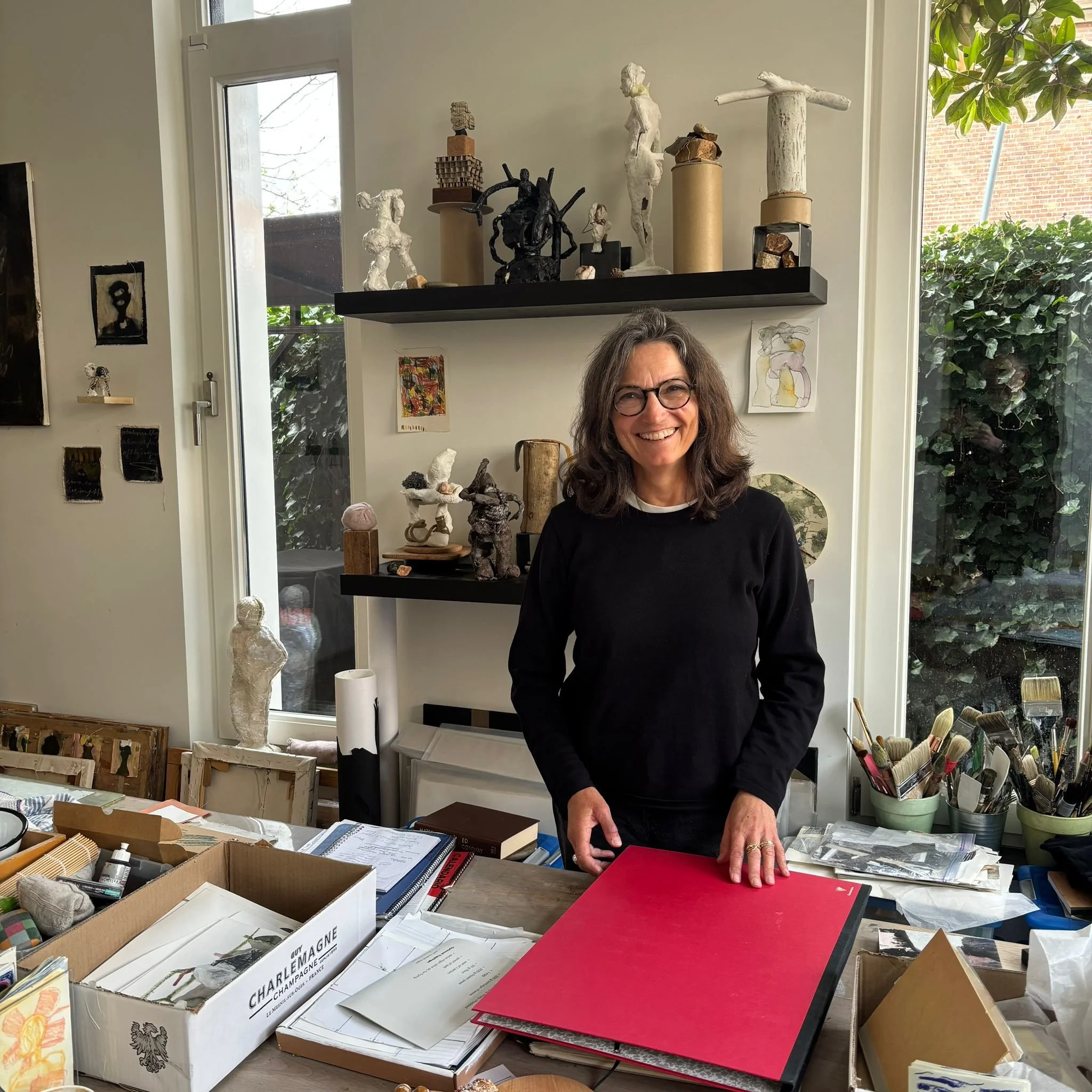
Some artists must be met in person before you can write about them. Not to gather information, but to understand the "feel" of the air in their studio. Marielle Schram is one such artist. This article grew out of a conversation; the rest of the work spoke for itself.
Text by Yves Joris, 2026 (Dutch text below/nederlandse tekst hieronder)
The bronze that waits
She starts with the bronze. Or rather, she starts with what bronze is teaching her about herself. A small sculpture—a favourite from a series she’s been working on for a while—is currently being cast in wax in Spain, at the studio of a sculptor near Schram's "home from home" in Girona. She is learning the ropes: the casting, the finishing, the entire painstaking process that precedes the final material. "It's so much work", she says, "A mammoth task." She laughs—not unhappily, but with the recognition of someone who has just understood why most sculptors outsource this stage. "The connection with the material," she continues, "that’s the fun part. The rest is a learning curve."
It is a good start to our conversation. Not because it is a revelation, but because it strikes exactly the right distance: she is in the middle of something, not on top of it. She isn't explaining; she’s thinking out loud. This, it turns out, is how Marielle Schram always works—within the work, not alongside it.
New York, Mexico City, London
Schram studied at Tilburg Academy in the 1980s: a five-year degree in drawing and painting. She then began teaching, but not for long; life had other plans. New York for a while. Then Mexico City for three years. Then London, where she stayed—for her husband’s work, she says, but also because she lingered in the way one lingers in places that allow you to exist. She drew and painted constantly. She taught on the side. She was a member of artist collectives, spent years in a co-operative running its own gallery space, and exhibited in open calls across London.
The British circuit shaped her attitude towards language and titles. In the Netherlands, she had been an "untitled" artist for years—no title, just the work. In London, she was told that "Untitled" wasn't an invitation to look. She began giving works titles, discovering she could keep them open to multiple interpretations, and eventually grew fond of the practice. Now, she feels a well-chosen title opens something up rather than closing it off. Yet the reflex to remain silent, to let the work speak for itself without the mediation of words, remains.
Paint that demands something else
Painting is her first love. She says this without hesitation, and you can hear that it isn't a ranking but a fact about the materials themselves: for her, paint is so inherently expressive that abstract thinking thrives in it naturally. The texture of paint demands something different from pencil or clay; they each lose themselves in their own way.
Her drawings stand autonomously—they are not studies for paintings or a preliminary stage for something else. She always works on loose sheets, never in a sketchbook. She wants to be able to shift them around, lay them side by side, hang them together, and see the dialogue between works without a book dictating the order. Furthermore, because she consistently uses mixed media, she lacks the patience to wait for a sketchbook page to dry. That, she says sincerely, is actually a very practical consideration.
But the practical reason masks something deeper. The loose sheets also engage in a different relationship with incompleteness. They hang. They react to one another. They might disappear into a box for a year and then reemerge, kept just long enough to become "right"—or not. Some works find a second life in a collage; others vanish for good. She holds them up to the light until she knows what they are.
The woman at the window
The figure in her work is the kind that disappears if you look for too long.
One of her works on paper shows a seated form, half-dissolved into vertical black strokes—paint or charcoal, applied thickly and rhythmically, like tree trunks or trails of raindrops. The background is a page from a book: an English typeface, visible but illegible beneath the layers of paint and collage. The figure wears orange, a warm core glowing against all that black and beige, but the face has been obscured, replaced by a white void. She is there and she isn't. You are looking at someone who is either fading or emerging; the direction is not clear.
This ambiguity isn't a trick. It recalls Edvard Munch, whom Schram has admired since the eighties—the first exhibition of his she saw moved her to tears—but also the later work of Käthe Kollwitz, seen in the hunched, introspective posture of the body. And in the layering itself—the printed language beneath the image, the text that supports without being read—there are echoes of Anselm Kiefer: as if the image rises out of the language, or is slowly sinking back into it.
The series she created around the theme of "the woman at the window"—inspired by Munch, by the old tradition of Vermeer’s woman reading a letter, and by the threshold between the internal and external worlds—demonstrates how this works. She began with a single idea: a woman, lost in thought, hands in her lap, by the window. The movement of thoughts coming and going; the feeling of sometimes vanishing, or conversely, being intensely present. From that one starting point, the series grew. She worked on several canvases at once—because paint takes time to dry, and you need something else to do while you wait. She lost herself in the image. She didn't think: I’ll put her here and then she’ll fade to the left. She thought: the background is pushing forward, and I’m letting it. In this way—organically, without a compositional blueprint—works were created that can be read like a comic strip in two directions: the person disappearing into the colour, or the person emerging from it. Both stories are true.
She struggles with work that is too "bang", she exclaims—too singular, too quickly explained. She wants honesty in her work—that word recurs again and again in the conversation, like a professional credo—but for her, honesty does not mean a single fixed meaning. You can see something from two sides and still be honest. In her view. But once you are...
She doesn't finish the sentence. She doesn't need to.
Poor materials, free spirit
The sculptures are her newest discipline and the most free. In their use of materials, they are unmistakably related to Arte Povera—the 1960s Italian movement that made noble art from "poor" materials, breaking the hierarchy between raw ingredients and art objects by working with what was at hand: stone, wood, string, cloth, earth. For Schram, it’s wire, foil, tape, twine, linen, air-drying clay, lava, cork. Materials that cost nothing and demand everything. She combines them not to be cheap, but because these substances possess a level of honesty that more expensive materials sometimes lack. They say what they are.
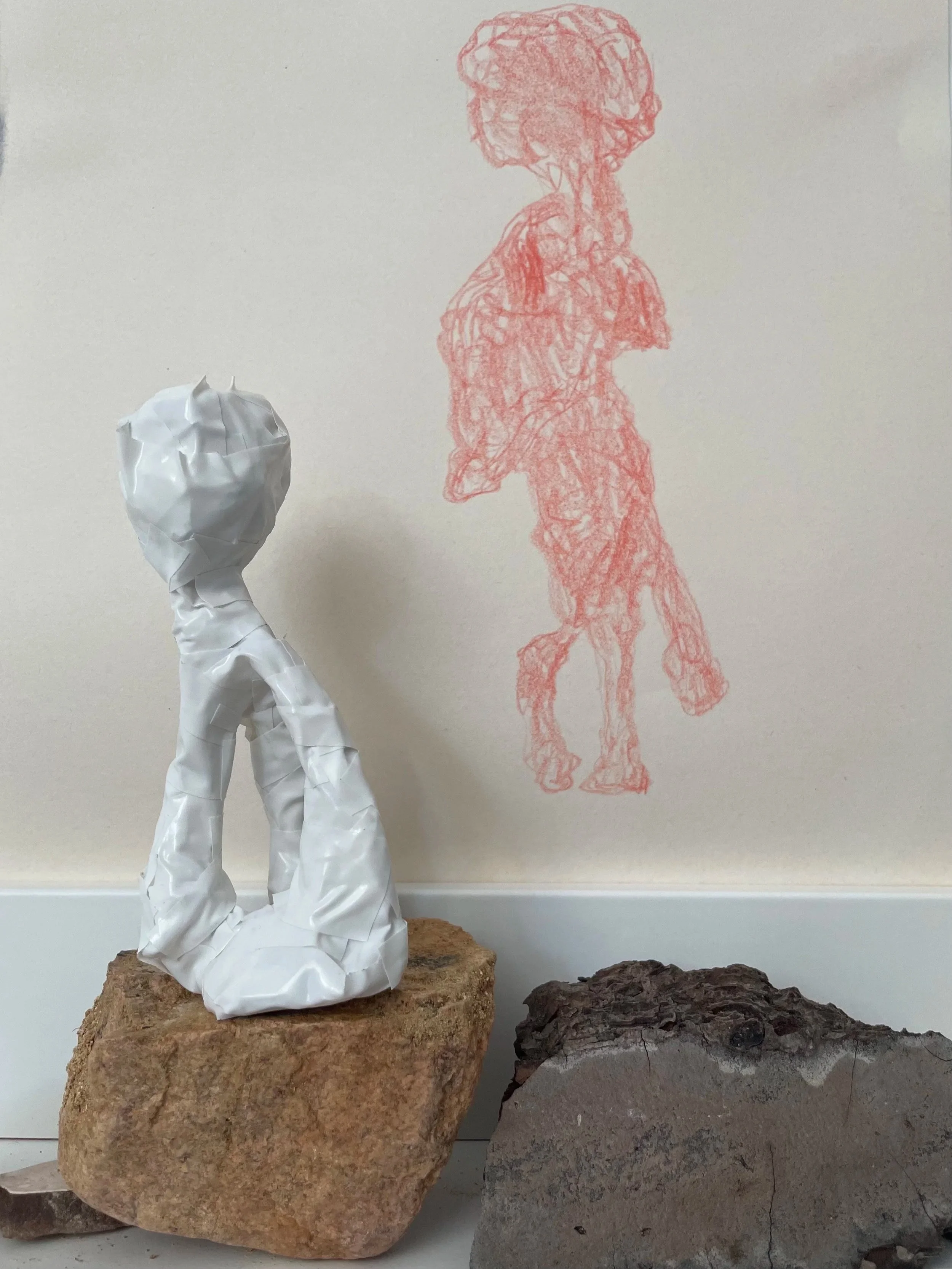
There is a white figure standing on a rough stone. It isn't large—you could pick it up with one hand. It’s made of foil and tape, and the fold lines haven't been smoothed away: they sit in the surface like creases in a sheet of paper that was once something else. The head is slightly too large for the body. The legs are thin yet anchored. It stands—and that independent stance is no accident. She wants the figures to be able to stand on their own two feet, she says. Pick-up-able, put-down-able, portable. They must carry something without collapsing under the weight of it.
Behind the figure, on the wall, is a red sketch in pencil—another body, looser, more movement, more flesh. Not a study for the sculpture, not a preparation. Rather the opposite: the energy the sculpture gave off when it fell still. The red line is what remains when you try to fix something in place and it escapes anyway. Together—the white, solidified figure and its red, restless shadow—they say more about Schram’s method than any explanation could. One follows from the other. One is never finished without the other.
The stone beneath is not a pedestal. "Pedestal" has too many connotations, she says—elevating someone, creating distance. For her, the base is part of the sculpture. "It belongs. If it doesn't belong, I don't do it. Then it's just ground."
She never formally studied sculpture. This makes her free with such innocence that she can no longer achieve in painting and drawing. Her extensive education taught her when to stop—"five years of study to know when to stop," she says—but that knowledge is also a brake. With the sculptures, she doesn't know enough to be inhibited. She is only curious.
Starting over
In 2024, Schram returned to the Netherlands after more than thirty years. Breda is new to her as a city—the contacts, the galleries, the network she slowly built in London are not automatically present here. She has to start again. But she says this without bitterness. She says it like someone who knows the work is always there, and that the rest is a matter of patience.
In June 2026, she will hold her first Dutch solo exhibition at the Princenhaags Museum in Breda. For her, it is a "business card"—not in the commercial sense, but the literal one: this is who I am, this is how I work, this is what I have to say. She wants a text she can take to galleries she finds interesting. Not to pitch herself, but to be able to start the conversation.
The conversation, not the explanation. That distinction is a serious one for her.
Sommige kunstenaars moet je bezoeken voor je over hen schrijft. Niet om informatie te verzamelen, maar om te begrijpen hoe de lucht in hun atelier aanvoelt. Marielle Schram is zo iemand. Dit stuk ontstond uit een gesprek. De rest deed het werk zelf.
Het brons dat wacht
Ze begint met het brons. Of eigenlijk: ze begint met wat het brons haar leert over zichzelf. Een klein beeldje, het lievelingswerk van de reeks die ze al een tijdje meedraagt, is nu in was gegoten in Spanje, bij een beeldhouwster met een atelier vlakbij. Ze is het aan het leren - het gieten, het bijwerken, het hele trage proces dat aan het definitieve materiaal voorafgaat. Jezus, zegt ze, het is zoveel werk. Gigantisch veel werk. En ze lacht, niet ongelukkig, maar met de herkenning van iemand die net begrepen heeft waarom beeldhouwers die stap uit handen geven. “De voeling met de materie,” zegt ze, “dát is het leuke. De rest is leercurve.”
Het is een goed begin van een gesprek. Niet omdat het onthullend is, maar omdat het precies de juiste afstand heeft: ze is middenin iets, niet er bovenop. Ze legt niet uit, ze denkt hardop. En dat blijkt de manier te zijn waarop Marielle Schram altijd werkt - in het werk, niet ernaast.
New York, Mexico City, Londen
De academie in Tilburg, in de jaren tachtig. Een vijfjarige opleiding tekenen en schilderen. Daarna les geven, maar niet lang, want het leven had andere plannen. New York, even. Dan Mexico City, drie jaar. Dan Londen, waar ze bleef - voor het werk van haar man, zegt ze, maar ook omdat ze er bleef hangen op de manier waarop je blijft hangen op plaatsen die je laten bestaan. Ze tekende en schilderde de hele tijd. Ze gaf les aan de zijlijn. Ze was lid van artistencollectieven, zat jarenlang in een coöperatie die een eigen galerieruimte runde, exposeerde bij open calls in heel Londen.
Dat Engelse circuit heeft iets gevormd in haar houding tegenover taal en titels. In Nederland was ze jaren untitled-kunstenaar - geen titel, gewoon werk. In Londen zei men haar dat dat geen uitnodiging was om te kijken. Ze begon titels te geven, ontdekte dat je ze meervoudig interpretabel kon houden, raakte er zelfs van gecharmeerd. Nu vindt ze, als ze eerlijk is, dat een goed gekozen titel iets opent in plaats van sluit. Maar de reflex om te zwijgen, om het werk voor zichzelf te laten spreken zonder de bemiddeling van woorden - die is gebleven.
Verf die iets anders wil
Schilderen is haar eerste liefde. Dat zegt ze zonder aarzeling, en je hoort dat het geen rangschikking is maar een feit over de materialen zelf: verf is voor haar zo expressief van aard dat het abstracte denken er vanzelf in gedijt. De textuur van verf vraagt iets anders dan potlood of klei. Ze verliezen zichzelf elk op hun eigen manier.
De tekeningen staan autonoom - ze zijn geen studie voor schilderijen, geen voorstadium van iets anders. Ze werkt altijd met losse bladen, nooit in een schetsboek. Want ze wil kunnen schuiven, de bladen naast elkaar leggen, naar elkaar hangen, de dialoog tussen de werken zien zonder dat het boek de volgorde dicteert. Als je bovendien veel materialen door elkaar gebruikt - en Schram doet dat consequent - heb je geen geduld om te wachten totdat het in een schetsboek droog is. Dat is, zegt ze met een rechttoe-rechtaan eerlijkheid, eigenlijk heel praktisch.
Maar de praktische reden verhult iets diepers. De losse bladen gaan ook een andere relatie aan met onvolledigheid. Ze hangen. Ze reageren op elkaar. Ze kunnen na een jaar in een doos verdwijnen en er dan toch weer uitkomen, net lang genoeg bewaard totdat ze goed zijn - of net niet. Sommige werken komen terug in een collage, andere verdwijnen voorgoed. Ze houdt ze tegen het licht totdat ze weet wat het is.
De vrouw bij het raam
De figuur in haar werk is van het type dat verdwijnt als je te lang kijkt.
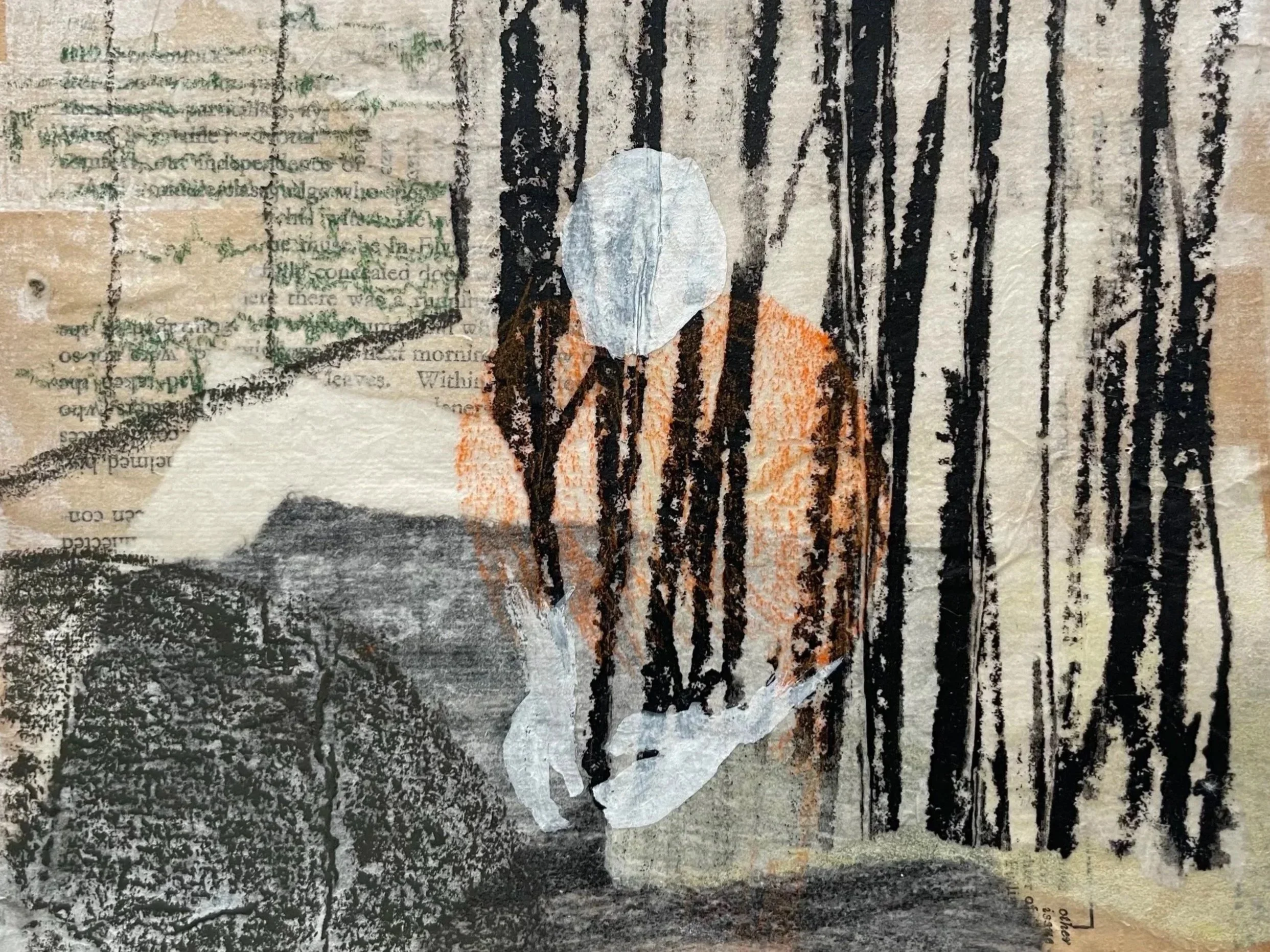
Een van de werken op papier toont een zittende gedaante, half opgelost in verticale zwarte strepen - verf of houtskool, dik en ritmisch aangebracht, als boomstammen of regensporen. De ondergrond is een pagina uit een boek: Engels lettertype, zichtbaar maar onleesbaar onder de lagen verf en collage. De figuur draagt oranje, een warme kern die oplicht tegen al dat zwart en beige, maar het gezicht is weggewerkt, vervangen door een wit vlak. Ze is er en ze is er niet. Je kijkt naar iemand die aan het verdwijnen is, of net aankomt - de richting is niet gegeven.
Die dubbelzinnigheid is niet een trucje. Ze herinnert aan Edvard Munch, die Schram al koestert sinds de jaren tachtig - de eerste tentoonstelling die ze van hem zag bracht haar tot tranen - maar ook aan de latere Käthe Kollwitz, in de gedrongen naar-binnen-gekeerde houding van het lichaam. En in de gelaagdheid zelf, de gedrukte taal onder het beeld, de tekst die draagt zonder gelezen te worden, klinkt iets door van Anselm Kiefer: alsof het beeld uit de taal oprijst, of er langzaam in terugzakt.
De serie die ze maakte rond het thema van de vrouw bij het raam - geïnspireerd door Munch, door de oude schildertraditie van Vermeers vrouw die een brief leest, door de grens tussen binnenwereld en buitenwereld - laat zien hoe dat werkt. Ze begon vanuit één idee: een vrouw, in gedachten verzonken, handen in de schoot, bij het raam. De beweging van gedachten die komen en gaan, het gevoel soms te verdwijnen, of net heel erg aanwezig te zijn. Vanuit dat ene vertrekpunt groeide de serie. Ze werkte aan meerdere doeken tegelijk - want verf droogt, en je hebt iets anders nodig in de wachttijd. Ze verloor zich in het beeld. Ze dacht niet: nu zet ik haar hier en dan verdwijnt ze naar links. Ze dacht: de achtergrond dringt naar voren en ik laat het toe. Op die manier - organisch, zonder compositieplan - zijn werken ontstaan die je als stripverhaal kunt lezen in twee richtingen: de persoon die verdwijnt in de kleur, of de persoon die eruit tevoorschijn komt. Beide lezingen zijn eerlijk.
Ze heeft moeite, zegt ze, met werk dat te boem is. Te enkelvoudig. Te snel uitgelegd. Ze wil eerlijkheid in haar werk - dat woord keert keer op keer terug in het gesprek, als een soort professionele geloofsbelijdenis - maar eerlijkheid betekent voor haar niet eenduidigheid. Je kunt iets van twee kanten zien en nog steeds eerlijk zijn. In haar optiek. Maar je bent een keer...
Ze maakt de zin niet af. Ze hoeft hem niet af te maken.
Arme materialen, vrije geest
De sculpturen zijn de jongste discipline en de meest vrije. En ze zijn, in hun materiaalgebruik, onmiskenbaar verwant aan de Arte Povera - die Italiaanse beweging uit de jaren zestig die edele kunst maakte van arme materialen, die de hiërarchie tussen grondstoffen en kunstobject opbrak door te werken met wat voorhanden was: steen, hout, touw, doek, aarde. Bij Schram: draad, folie, tape, touw, linnen, zelfdrogende klei, lava, kurk. Materialen die niets kosten en alles vragen. Ze combineert ze niet om goedkoop te zijn, maar omdat deze stoffen een eerlijkheid hebben die duurder materiaal soms mist. Ze zeggen wat ze zijn.
Er staat een wit figuur op een ruwe steen. Niet groot - je kunt het oppakken met één hand. Het is gemaakt van folie en tape, en de vouwlijnen zijn niet weggewerkt: ze zitten in het oppervlak zoals rimpels in een vel papier dat ooit iets anders was. Het hoofd is iets te groot voor het lichaam. De benen zijn dun en verankerd tegelijk. Het staat - en dat zelfstandig staan is geen toevalligheid. Ze wil dat de beelden op eigen benen kunnen staan, zegt ze. Opraapbaar, neerzetbaar, draagbaar. Ze moeten iets meedragen zonder eronder te bezwijken.
Achter de figuur, op de muur, een rode schets in potlood - een ander lichaam, losser, meer beweging, meer vlees. Niet de studie voor het beeld, niet de voorbereiding. Eerder het omgekeerde: de energie die het beeld heeft afgegeven toen het stilviel. De rode lijn is wat er overblijft als je iets probeert vast te zetten en het toch ontsnapt. Die twee samen - het witte gestolde figuur en zijn rode, beweeglijke schaduw - zeggen meer over Schrams werkwijze dan elke uitleg zou kunnen. Het ene volgt uit het andere. Het ene is nooit af zonder het andere.
De steen daaronder is geen voetstuk. Voetstuk heeft te veel connotaties, zegt ze - iemand verheffen, afstand creëren. Voor haar is de basis een deel van het beeld. Zij hoort erbij. Als ze er niet bij hoort, doen we het niet. Dan is het is gewoon grond.
Ze heeft nooit een sculpturenopleiding gevolgd. En dat maakt haar vrij op een manier die ze in schilderen en tekenen, ondanks alle jaren ervaring, niet meer zo onbevangen kan bereiken. De opleiding heeft haar geleerd wanneer ze moet stoppen - vijf jaar gestudeerd om te weten wanneer ik moet stoppen, zegt ze - maar die kennis is ook een rem. Bij de beelden weet ze niet genoeg om geremd te worden. Ze is alleen maar nieuwsgierig.
Opnieuw beginnen
In 2024 keerde Schram terug naar Nederland na meer dan dertig jaar. Breda is nieuw voor haar als stad - de contacten, de galeries, het netwerk dat ze in Londen langzaam had opgebouwd, is hier niet vanzelfsprekend aanwezig. Ze moet opnieuw beginnen. Maar ze zegt het zonder bitterheid. Ze zegt het als iemand die weet dat het werk er altijd al was, en dat de rest een kwestie van geduld is.
In juni 2026 toont ze haar eerste Nederlandse solotentoonstelling in het Princenhaags Museum in Breda. Voor haar is het een visitekaartje - niet in de commerciële zin, maar in de letterlijke: dit is wie ik ben, dit is hoe ik werk, dit is wat ik te zeggen heb. Ze wil een tekst, die ze mee kan nemen naar galeries die ze interessant vindt. Niet om zichzelf aan te prijzen, maar om het gesprek te kunnen beginnen.
Het gesprek, niet de uitleg. Dat onderscheid is haar serieus.
Door Yves Joris, april 2026